
_edited.png)
Transforming a Period Property into a Passivhaus: A Case Study from Histon, Cambridge
- Dimension Creative

- Mar 1, 2024
- 3 min read
When it comes to retrofitting period properties with modern energy efficiency standards, the challenge often lies in reconciling the need for the building to breathe with the stringent air tightness required by Passivhaus standards. This delicate balancing act was masterfully achieved by Emmerson Critchley Ltd in their Histon project, Cambridge, where an old barn was converted into two passive houses. Let us delve into how this remarkable transformation was accomplished, preserving the character of the period property while meeting and exceeding contemporary energy efficiency standards.
Understanding the ChallengePeriod properties, with their unique charm and historical value, often come with a significant challenge: they need to breathe. Traditional construction methods ensured that these buildings could manage moisture through natural ventilation, avoiding the pitfalls of condensation and damp. However, modern energy efficiency standards, particularly those required for a building to qualify as a Passivhaus, demand exceptional levels of air tightness, high thermal insulation, and minimal thermal bridging.
This project in Histon, Cambridge, serves as a case study for overcoming these challenges. The subject of this retrofit was an old barn, a structure inherently designed to be breathable, making the task of converting it into a Passivhaus a formidable one.

The Approach: A Dual-Shell StrategyThe solution employed by Emmerson Critchley Ltd was both innovative and effective: creating a dual-shell construction. This approach involved retaining the external envelope of the barn as fully breathable, thus preserving its ability to manage moisture naturally. Meanwhile, an independent inner shell was developed to meet the rigorous standards of air tightness and insulation required for Passivhaus certification.
Key Strategies EmployedEliminating Cold Bridging: One of the primary challenges in retrofitting period properties for energy efficiency is the elimination of cold bridging—areas in the building envelope that allow heat to escape more readily. Through careful design and construction practices, the project team successfully minimised cold bridging, thereby reducing heat loss and improving overall energy efficiency.
Maximizing U-Value: The U-value measures how well a building component, like a wall, roof, or window, can keep heat inside the building. To meet Passivhaus standards, the team maximized the U-value of the building’s components, ensuring that the insulation levels were high enough to retain heat effectively.
Managing Condensation: The dual-shell strategy was pivotal in managing condensation risk. By maintaining the breathability of the outer shell, moisture could be effectively managed, while the air-tight inner shell ensured that the living spaces remained warm and dry.
Independent and Breathable External Envelope: This innovative construction approach allowed the building to maintain its traditional moisture management through the breathable outer envelope, while the inner shell provided the necessary thermal insulation and air tightness.
Achieving and Exceeding Standards The Histon project not only met the required standards for Passivhaus certification but exceeded them. The inner shell of the barn conversion demonstrated exceptional U-value performance, surpassing the thresholds set by building control. Furthermore, the project passed the air tightness test, a crucial criterion for Passivhaus certification, proving that even period properties could achieve modern energy efficiency standards without compromising their inherent need to breathe.
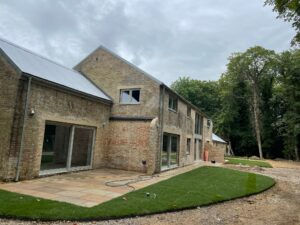
Conclusion The successful conversion of the old barn in Histon, Cambridge, into two passive houses by Emmerson Critchley Ltd stands as a testament to the feasibility of retrofitting period properties to meet Passivhaus standards. This project underscores the importance of innovative construction techniques, such as the dual-shell strategy, in overcoming the inherent challenges of such undertakings. It serves as a valuable case study for architects, builders, and homeowners alike, demonstrating that with the right approach, even the most challenging buildings can be transformed into models of energy efficiency while preserving their historical integrity.


Comments